

DR TIM EPPLEY
Chief Conservation Officer
Dr. Tim Eppley leads the organization’s science-based conservation programs across protected areas and landscapes throughout Madagascar. A conservation biologist specializing in primate behavioral ecology and biodiversity conservation, his work integrates field research, wildlife monitoring, habitat protection, environmental education, and community engagement to develop evidence-based conservation strategies that benefit both wildlife and people. He oversees conservation and research initiatives addressing threats to Madagascar’s biodiversity while supporting local communities through sustainable livelihoods, education, and community-led conservation.
Tim’s research focuses on the behavioral ecology and conservation of Madagascar’s lemurs, with particular interests in how species respond to habitat disturbance, environmental variability, and other anthropogenic pressures. His work has included long-term behavioral and ecological research, biodiversity surveys, population monitoring, and conservation assessments across Madagascar’s rainforests, dry forests, and spiny forests. He is a co-author of the fifth edition of Lemurs of Madagascar, the definitive reference on the island’s lemur diversity. Tim serves as Red List Authority Coordinator for the IUCN SSC Primate Specialist Group (PSG) and is a member of the PSG’s Executive Committee, contributing to global efforts to assess and conserve the world’s primate species.
Before joining Wildlife Madagascar, Tim spent five years as a Postdoctoral Research Fellow in Conservation Science & Wildlife Health and as Co-lead of the African Forest Conservation Hub at San Diego Zoo Wildlife Alliance, where he established and expanded a multi-disciplinary conservation research program in Madagascar. His work has fostered collaborations among universities, zoological institutions, government agencies, and conservation organizations, while providing research and mentorship opportunities for students and early-career conservationists.
Tim received a B.S. in Zoology from Michigan State University, an M.Sc. in Primate Conservation from Oxford Brookes University in the United Kingdom, and a Ph.D. in Animal Ecology and Conservation from Universität Hamburg in Germany. He is also a Visiting Scholar in the School of Earth, Environment, & Society at Portland State University.
Q&A with Tim Eppley
What drew you to a career in wildlife conservation?
I’ve always been drawn to wildlife, and from a young age I would spend most of my time outdoors, exploring nearby woods and searching for wildlife. I even created a “nature club” and recorded the wildlife I saw, though I was mostly just following and observing squirrels and groundhogs! In the years that followed, our family vacations were largely centered around visiting national parks in the US and Canada, exposing me to new wildlife and landscapes that were very different from those in my home state of Michigan. These experiences and my love of wildlife led me to pursue both undergrad and graduate degrees in zoology and conservation, along with numerous field research projects in far-flung tropical forests. Through each experience, I came to be acutely aware of the immense pressures being forced on wildlife and wanted to devote myself to helping protect and conserve little-known species.
Who or what has inspired you?
As a primatologist, Jane Goodall is the most obvious answer, since she has inspired multiple generations of animal behaviorists with her incredible stories and groundbreaking research. However, I’m even more inspired by her later work and mission, focusing on the mixture of environmental, conservation, and humanitarian issues.
What book or film has influenced you or made a strong impression?
This is a tough question! Early on, I was captivated by Aldo Leopold’s “A Sand County Almanac” and by Edward Abbey’s “Desert Solitaire.” There are several similarities between the two, largely exploring the relationship between humans and the environment, as well as the need for and complexity of conservation. Later, once I began fieldwork in Africa, I found myself completely taken by Robert Sapolsky’s “A Primate’s Memoir,” which beautifully and humorously interwove his personal fieldwork successes and missteps, many of which were similar to situations I was experiencing at the time.
What is one of the coolest experiences you’ve had in your work?
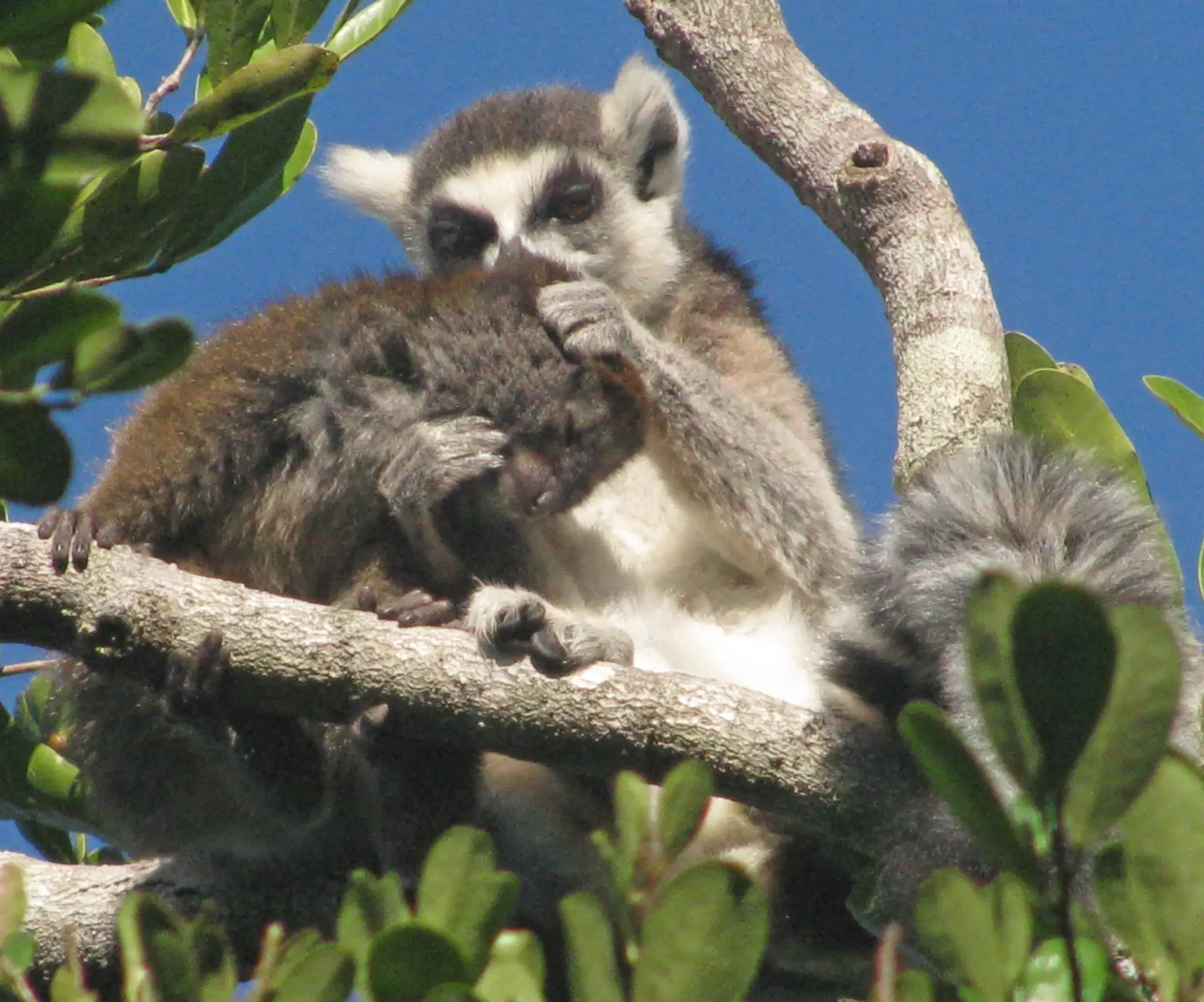
During my PhD fieldwork, I studied three groups of southern bamboo lemurs. I would essentially spend the entire day with each group, following them from sunrise to sunset, collecting data on everything relating to the behavioral and feeding ecology. By itself, this was an incredible experience, observing a lemur species that had never been studied before. One thing that became quickly apparent was bamboo lemurs are very territorial, and their encounters with other lemurs were often antagonistic. Strangely, however, one of my study groups had a female ring-tailed lemur living with them! Ring-tailed lemurs were not known from this forest, and it was likely that this individual escaped from a nearby botanical garden. Regardless of where she came from, and not having other ring-tailed lemurs to form a social group with, she somehow managed to integrate herself into this bamboo lemur group (see photos below). I’m unsure how long they lived together prior to my observations, but over the course of my nearly two-year project, the ring-tailed lemur was almost always with the bamboo lemurs. This unusual affiliative association was fascinating, but perhaps most interesting was that one of the female bamboo lemurs relied on the ring-tailed lemur as a babysitter, leaving her infant with the ring-tailed lemur while she fed in nearby trees. The infant climbed all over the ring-tailed lemur, treating her like a jungle gym. On a number of occasions, I would even see the ring-tailed lemur transport the infant back to its mother when the group moved on to forage in other areas of the forest.

Why do you care about Madagascar and its wildlife? Why do you want to work there?
Madagascar is known as the Eighth Continent due to its incredible biodiversity—including all lemur species—which is found nowhere else on Earth. My first trip to Madagascar was in 2006, and since then I have been completely enamored with this incredible island nation and visited many sites throughout the country. Malagasy people are among the nicest in the world, and many living in rural areas are acutely aware of how important their native forests are. Unfortunately, many of these forests are being destroyed at a rapid rate, which puts immediate pressure on the wildlife and will eventually be detrimental to the Malagasy people. It is this situation of wanting to protect the incredible and unique wildlife of Madagascar and find equitable and sustainable solutions for Malagasy people living near these forests, that drives me to work in Madagascar.