
Madagascar Serpent-Eagle
Eutriorchis astur
Endangered
STATUS
Endangered
SIZE
Body length: 22.4 to 26 in (57 to 66 cm)
HABITAT
Tropical rainforest
DIET
Reptiles
Occasionally bats
or insects
LIFESTYLE
Diurnal
Arboreal
Social
REPRODUCTION
Gestation: 40 days
Young: 1 egg
THREATS
Habitat loss
Deforestation

INTERESTING FACTS
This eagle spends a large part of its day perched motionless below the forest canopy and spends very little time flying or soaring. You might find them by listening for a frog-like call coming from high up in the trees.
Despite its name, the Madagascar serpent-eagle feeds more on lizards than on snakes. It will also prey upon tree frogs and occasionally bats and insects.
This eagle typically only lays one egg after breeding. Both the female and the male take care of the egg and the chick.
Characteristics
Endemic to Madagascar and confined largely to the island’s eastern rainforests, the Madagascar serpent-eagle was once feared lost forever, after decades with virtually no confirmed sightings. But then it was rediscovered in 1993. Today, it remains one of Madagascar’s rarest birds of prey, and an example of how much there is still to learn about the island’s forests.
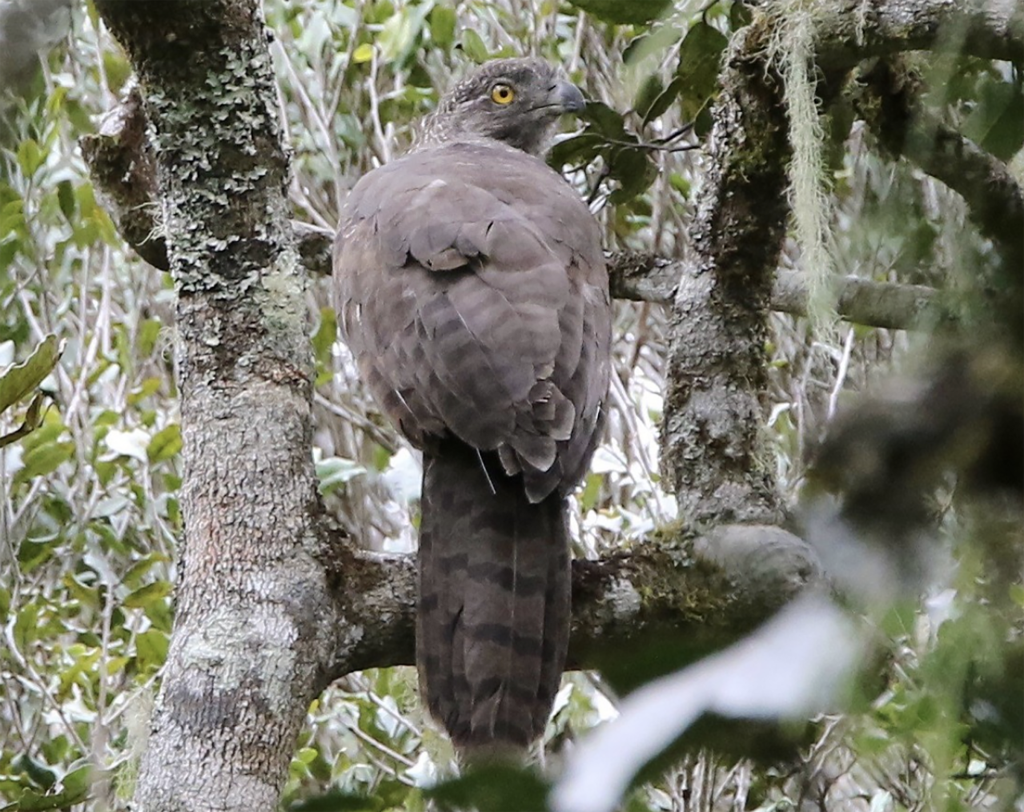
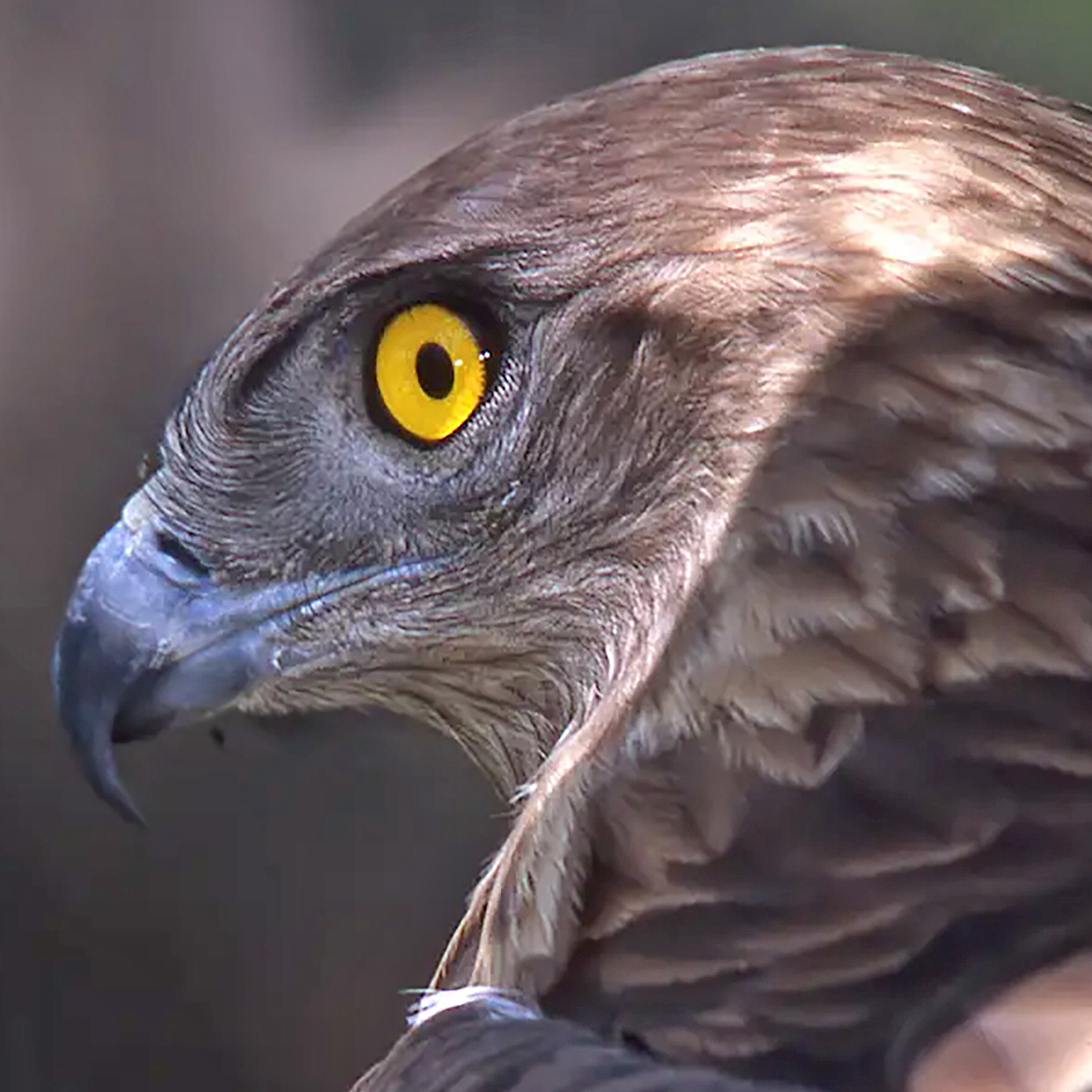
This elusive, medium-sized bird of prey is the only member of its genus. It has a distinctive combination of features suited to hunting beneath a dense forest canopy: relatively short, rounded wings, a very long, rounded tail, strong yellow legs, powerful talons, and a sharply hooked bill. Its plumage is predominantly dark brown to gray above and paler below, with barring across much of the body. Its long tail and compact wings give it an appearance quite different from the broad-winged eagles that soar over open landscapes.
Despite its imposing name, the Madagascar serpent-eagle is better thought of as a highly specialized forest hunter, built for maneuvering through trees rather than soaring for long distances over open country. Its coloring and secretive habits make it difficult to spot.

Habitat
The Madagascar serpent-eagle lives in dense, humid evergreen forest, particularly the lowland and mid-elevation rainforests of eastern Madagascar. Its known range stretches through some of the island’s most important remaining forest landscapes, including the Masoala Peninsula and forests farther north and south. It generally favors large, relatively uninterrupted areas of primary forest and rarely ventures far beyond the forest edge. That dependence on intact forest makes the species a reminder that protecting biodiversity is not simply about saving individual animals, it is also about keeping entire ecosystems connected and functioning.
Foods and Feeding
The Madagascar serpent-eagle’s common name is a bit misleading. Although it eats snakes, they appear to make up only a small portion of its diet. Instead, this eagle has a particular fondness for reptiles that spend their lives among Madagascar’s trees and vegetation. Chameleons and geckos are especially important prey, while lizards, frogs, and snakes are also taken.
In research of the species’ nesting biology, chameleons and leaf-tailed geckos accounted for 83 percent of 133 identified prey items. The prey included chameleons from the genera Furcifer and Calumma and leaf-tailed geckos Uroplatus. Rather than being mostly a snake specialist, the Madagascar serpent-eagle is a predator with a particular talent for hunting reptiles of various kinds.
Its hunting technique is equally well suited to this lifestyle. From a concealed perch, the eagle watches the vegetation below and launches when it detects potential prey, using its powerful feet and talons to grab its target. In the rainforest, the ability to make quick, controlled flights between trees is far more useful than the ability to soar long distances.

Behavior
Madagascar serpent-eagles are primarily forest birds, spending much of their time perched quietly within the canopy. Rather than constantly circling overhead, they can sit patiently on a substantial branch and scan the surrounding vegetation for movement. When prey is spotted, the eagle can launch from its perch and make a short, direct flight through the forest to seize it. This hunting style makes perfect sense in a habitat where dense vegetation leaves little room for the dramatic soaring flights associated with many other eagles.
Their secretive nature has contributed to the species’ reputation as one of Madagascar’s great avian mysteries. This species went decades without a confirmed observation by an ornithologist and was once considered possibly extinct. Its rediscovery demonstrated how a forest-dwelling species can disappear from scientific view without necessarily disappearing from the forest itself. Even today, researchers are still filling important gaps in knowledge about its movements, population size, behavior, and ecology.
Reproduction and Life Cycle
For a bird that spent so long hidden from science, every glimpse into the Madagascar serpent-eagle’s family life is significant. The first nest known to science was discovered on the Masoala Peninsula in 1997. Rather than constructing a conventional nest entirely from sticks, the pair used an bird’s-nest fern (Asplenium nidus) growing high in a tree, reinforcing it with vines and branches and lining the center with leaves. The nest was about 20 meters above the ground, well above the forest floor and safely tucked into the canopy.
That nest contained a single white egg, highlighting one of the challenges facing such a rare predator: producing only a small number of young means that population recovery can be slow. Both parents participated in incubation, although the female spent considerably more time on the egg during the observations. The egg hatched after about two weeks of observations, and the young eagle eventually fledged at approximately 62 days old.
Because so few nests have been documented, scientists still know surprisingly little about the species’ complete reproductive cycle, pair bonds, territory size, and lifespan. What is clear is that its specialized forest lifestyle, small reproductive output, and dependence on mature habitat make the survival of established breeding populations especially important.
Conservation and Threats
The Madagascar serpent-eagle is currently classified as Endangered and remains one of the world’s rarest birds of prey. After disappearing from records for decades, it was once regarded as potentially extinct before its rediscovery in 1993. More recent research has shown that it is more widely distributed than once believed, and updated estimates suggest a larger population than the early assessments would indicate, but the species is still declining and remains highly vulnerable.
The biggest threat is the loss and fragmentation of Madagascar’s eastern rainforest. Deforestation, forest degradation, and the breaking apart of large forest blocks can remove the mature habitat this eagle needs for hunting and nesting. Because it is so strongly tied to intact forest, protecting remaining rainforest is one of the most important things conservationists can do for the species. Climate change may add another layer of pressure by altering the forests on which the eagle and its prey depend.
There is, however, reason for hope. Research has shown that the Madagascar serpent-eagle occurs across a greater area of protected forest than previously recognized, helping conservationists identify important populations and prioritize habitat protection. Continued surveys, monitoring, and research are essential, not only to count these elusive birds but also to understand how they respond to changes in their forest environment.